İzmir History: A Short Timeline Tied to Places You Can Visit
İzmir history in a short timeline, from Yeşilova Mound and Old Smyrna to Roman Smyrna, the 1922 fire and the modern city, linked to sights you can still see.
On this page
İzmir's story runs from a neolithic mound in the Bornova plain to a modern port city, and the earliest settlement named in the records is Yeşilova Mound, first occupied around 6500 BCE. This guide follows that timeline through the places you can still find on a map, from the Temple of Athena at Old Smyrna to the Kemeraltı bazaar and the Historical Elevator.
İzmir was Smyrna for most of its history, a name you will still see on Roman inscriptions and in guidebooks. The city has moved site at least once, burned and rebuilt, so its monuments sit in different neighbourhoods rather than in one archaeological park.
What İzmir was called before: Smyrna and the names behind it
İzmir is the Turkish form of Smyrna, the name the city carried through the Greek, Roman and Ottoman centuries, and the modern spelling was adopted in 1928 as part of the language reform. The city's past is a sequence of cultures and empires rather than a single line, which is why its sights are scattered across the centre.
In the late Ottoman period the port was known informally as Gâvur İzmir, or Infidel İzmir, because of its large non-Muslim merchant population, and an 1890 to 1905 French plan of Smyrna is often reproduced alongside accounts of that era. That trading city, with its bazaars, churches, synagogues and department stores, is the direct predecessor of today's centre.
The first settlement at Yeşilova Mound and the visitor centre in Bornova
Yeşilova Mound, in Bornova district, is identified as İzmir's first prehistoric settlement, with occupation beginning about 8,500 years ago in the Neolithic Age; excavations began in 2005 after the site was identified in 2003. Finds include sea bream bones, shellfish remains and pottery decorated with panther motifs, which point to a community that farmed, fished and worked stone and clay.
The Yeşilova Visitor Centre in Bornova runs guided programmes using interactive presentation techniques, and reconstructions of the neolithic huts are built from materials matching the archaeological evidence. Treat it as a half-day trip from the centre, and check the current visiting arrangements before you travel.
Old Smyrna: Aeolian founders, the Temple of Athena and the Homer connection
Old Smyrna was founded by Aeolian Greek settlers, and the site at the foothills of Mount Yamanlar, with its access to the gulf, grew rich on trade and raised monumental buildings including the Temple of Athena. The settlement's golden period came in the first half of the Archaic Age, and the visible remains are the shape it took from the tenth century BCE onwards.
Old Smyrna is one of the strongest candidates for Homer's hometown, supported by ancient literary references and by the Aeolic and Ionian dialects in which the epics were composed, though no source places his birth there with certainty. Walk the site with that caveat in mind: the columns are real, the biography is not settled.
Alexander the Great and the move to the slopes of Mount Pagos (Kadifekale)
In the fourth century BC, at the initiative of Alexander the Great, the city was relocated to a more defensible site at the foot of Mount Pagos, the hill now called Kadifekale. That decision explains the layout of central İzmir: the Roman remains sit near the base of the hill rather than on the old Aeolian site.
The relocation marked the start of a long prosperous stretch for Smyrna, which competed with Ephesus and Pergamon for the title of first city of Asia and appears in the Bible as one of the Seven Churches of Revelation. Start from the waterfront and work uphill if you want to see why the site was chosen.
Roman Smyrna: the agora, the earthquake of 178 AD and rebuilding under Marcus Aurelius
Smyrna became part of the Roman Republic in 133 BC and entered one of its most prosperous periods, with an agora that served as the centre of social, political and commercial life. A severe earthquake destroyed the city in 178 AD, and it was rebuilt with support from the Roman Emperor Marcus Aurelius.
The Ancient Greco-Roman Market of Smyrna, founded in the fourth century BC, survives as an open site with columns, gates, temples and corridors, and it is one of the easiest ancient stops to fit into a city walk. Visit it alongside the city's museums for context.
The Byzantine, Seljuk and Ottoman centuries in brief
The city was taken for the first time by the Seljuk Turks under Çaka Bey in 1084, recovered by the Byzantine Empire in 1097 during the First Crusade, and then gradually captured by the Aydın Beylik between 1317 and 1329. Tamerlane's troops took and destroyed the coastal fortress in 1402, and around 1425 Smyrna was definitively incorporated into the Ottoman Empire.
Under Ottoman rule the port became one of the most important international trading points in the Mediterranean, drawing European, Armenian and Greek merchant capital and earning the description Gateway of the Ottoman Empire to the West. The first railway line in Anatolia, İzmir to Aydın, opened in 1856, and in 1864 the city became the administrative centre of the Aydın Vilayet. That commercial wealth is what the Kemeraltı bazaar still trades on.
The 1922 fire and the remaking of the city centre under the Republic
In September 1922, during the Greco-Turkish War, Turkish forces entered the city and the Great Fire of Smyrna destroyed a significant part of it, including the commercial and residential quarters and the waterfront. The Republic was proclaimed in 1923, and the reconstruction that followed produced modern avenues and squares in place of the burned grid.
That is why central İzmir reads as a modern city with pockets of older fabric: the surviving Ottoman streets are concentrated in the bazaar quarter and around Konak, while the sea front is largely twentieth-century. Start any walk from Konak Square and work inland, using our guide to Izmir Old Town, rather than expecting a single preserved historic core.
The Kültürpark and the İzmir International Fair
The first İzmir International Fair was organised in 1927 at the initiative of Mustafa Kemal Atatürk, and the Culture Park, or Kültürpark, was laid out as part of the Republic-era rethinking of the urban space. The park remains the green centre of the modern city and is the venue for the fair.
The fair runs for ten days in September, with traders and start-ups exhibiting alongside concerts and theatre performances, so early autumn brings extra crowds and events to the city centre. If you want a quiet park walk, choose another week.
What survives to see today: Kemeraltı, the agora, the Clock Tower and the Historical Elevator
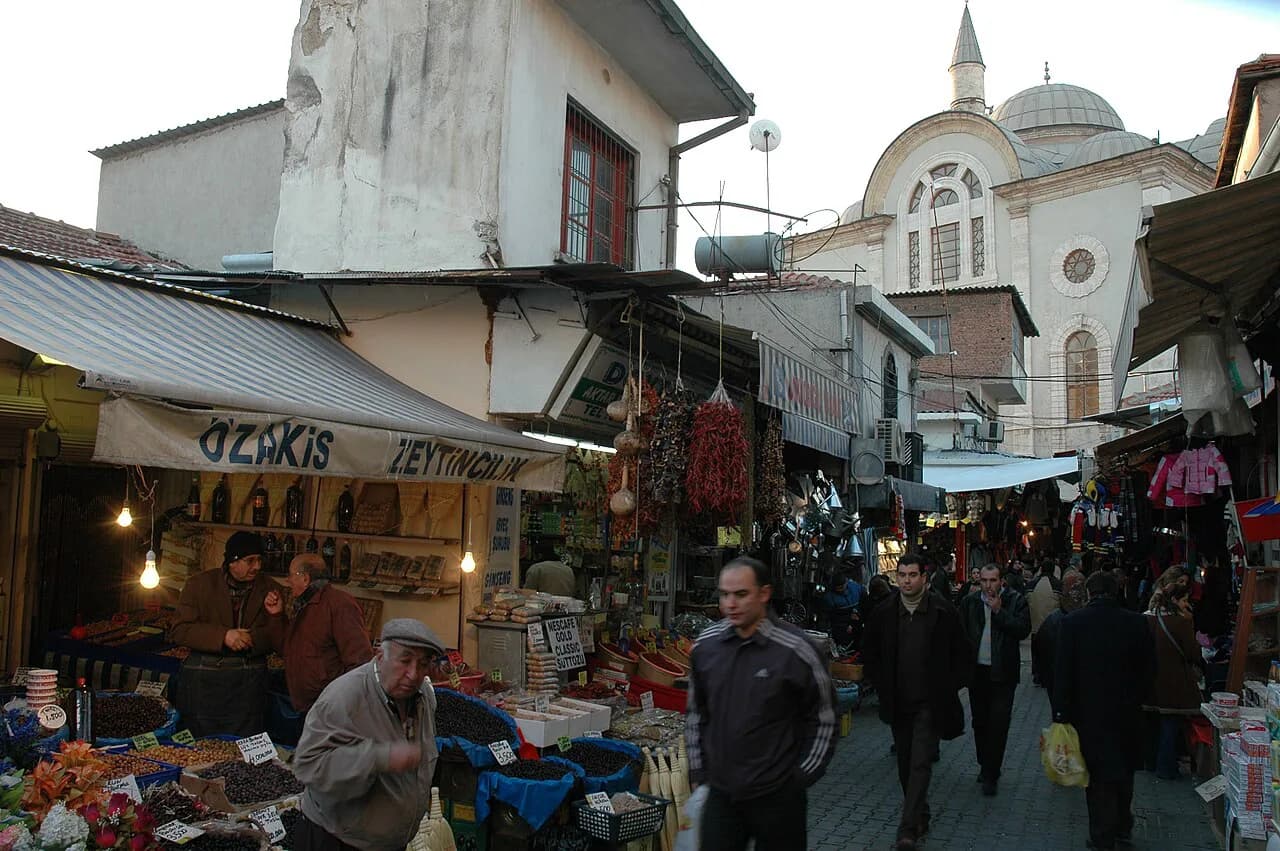
The Kemeraltı bazaar is the traditional market of the city, where you can buy ceramics, clothes and jewellery and stop for Turkish tea, and it sits close to the centre alongside the Agora of Smyrna. Allow a couple of hours for the bazaar streets and pair them with the Roman market on the same morning.
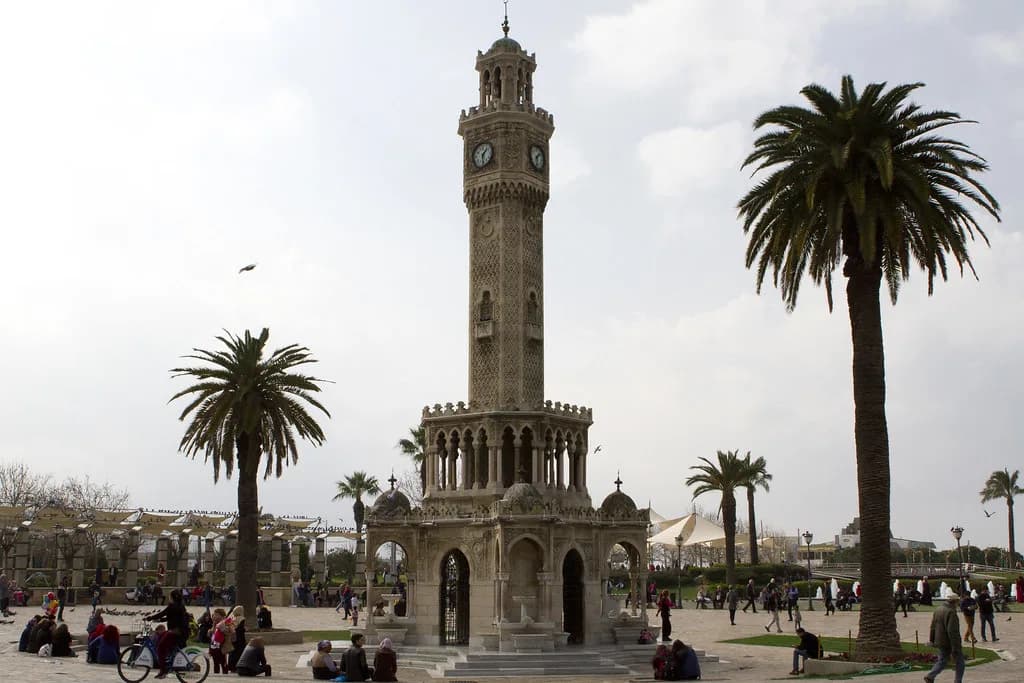
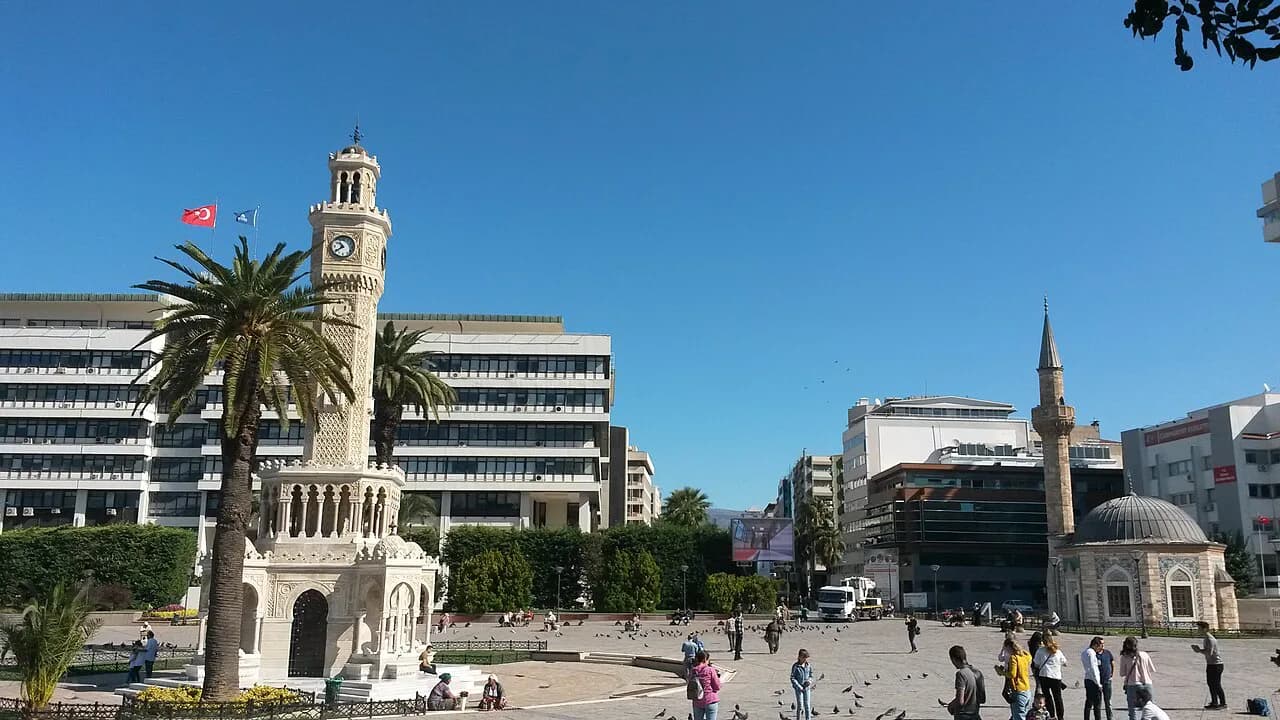
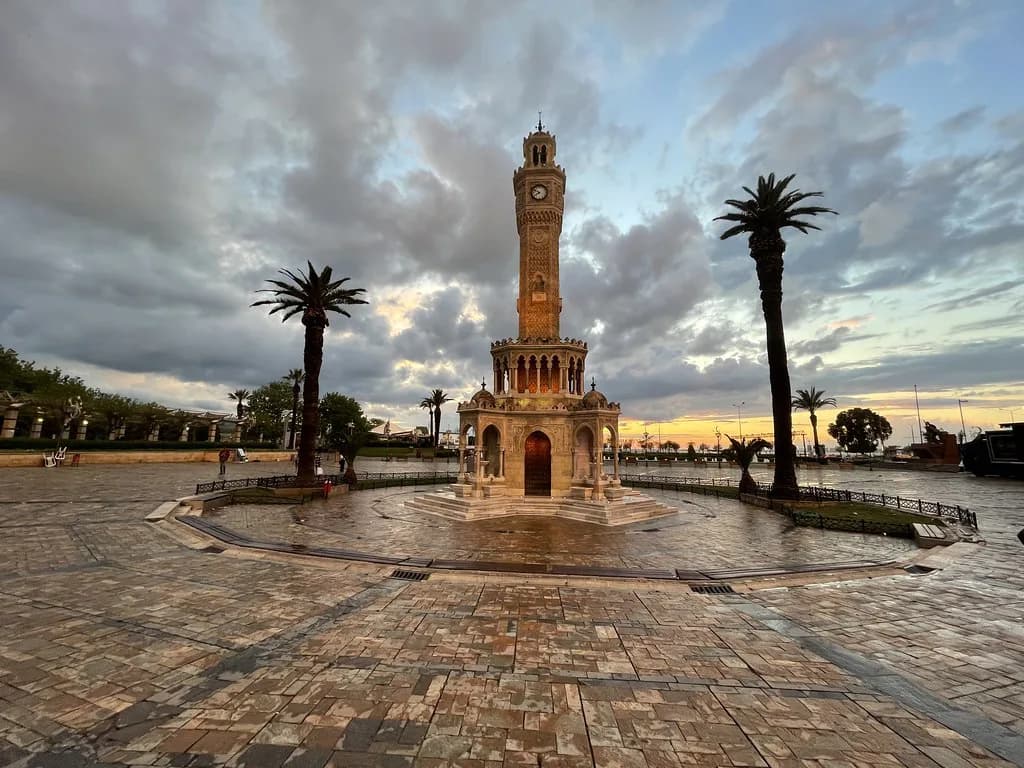
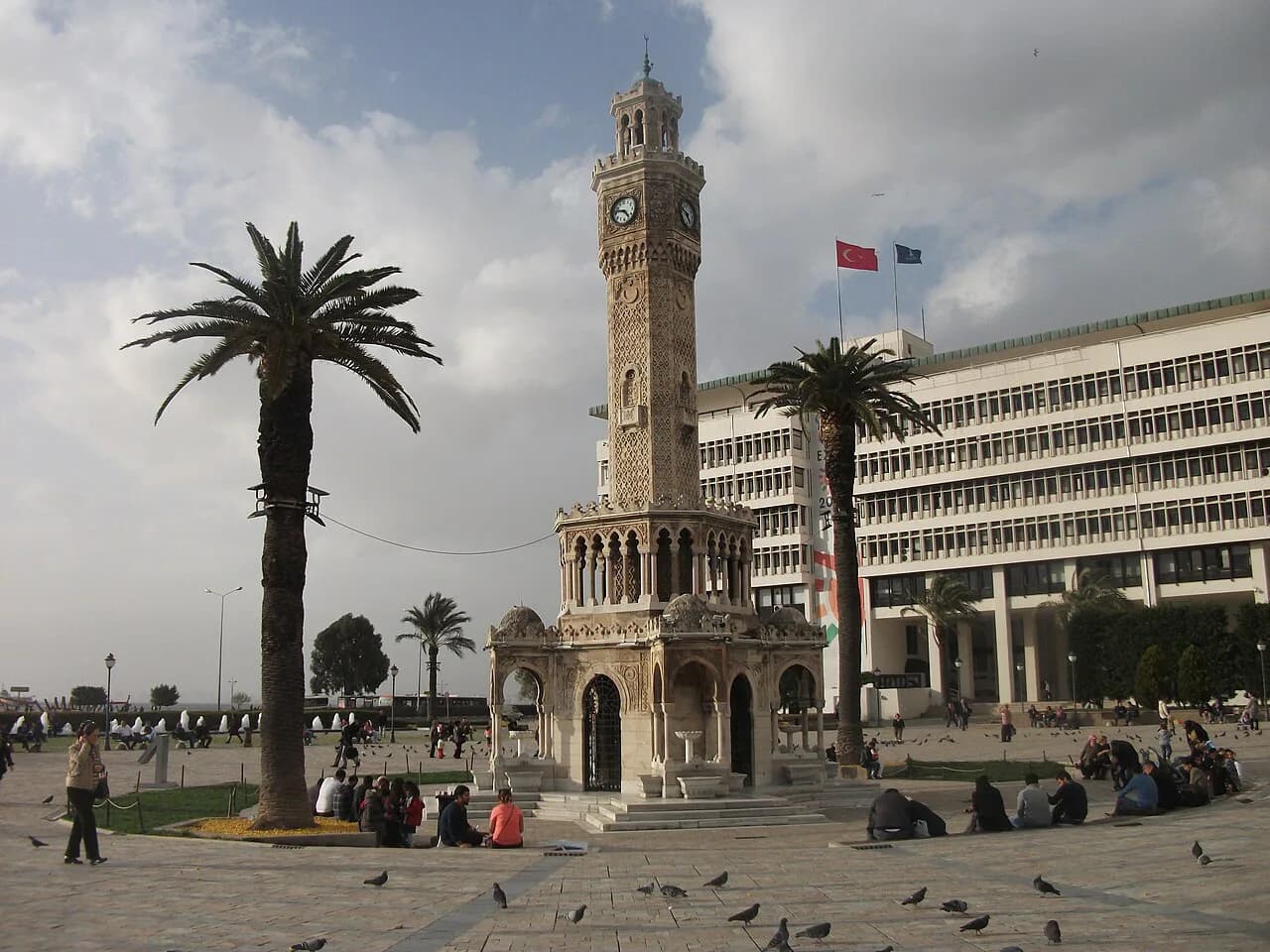
Konak Square holds the Clock Tower, the city's most photographed landmark, and the square is the natural starting point for the surrounding old streets and the waterfront. A short walk away, the Historical Elevator Tower, İzmir Tarihi Asansör Binası, gives a view over the sea and the gulf.
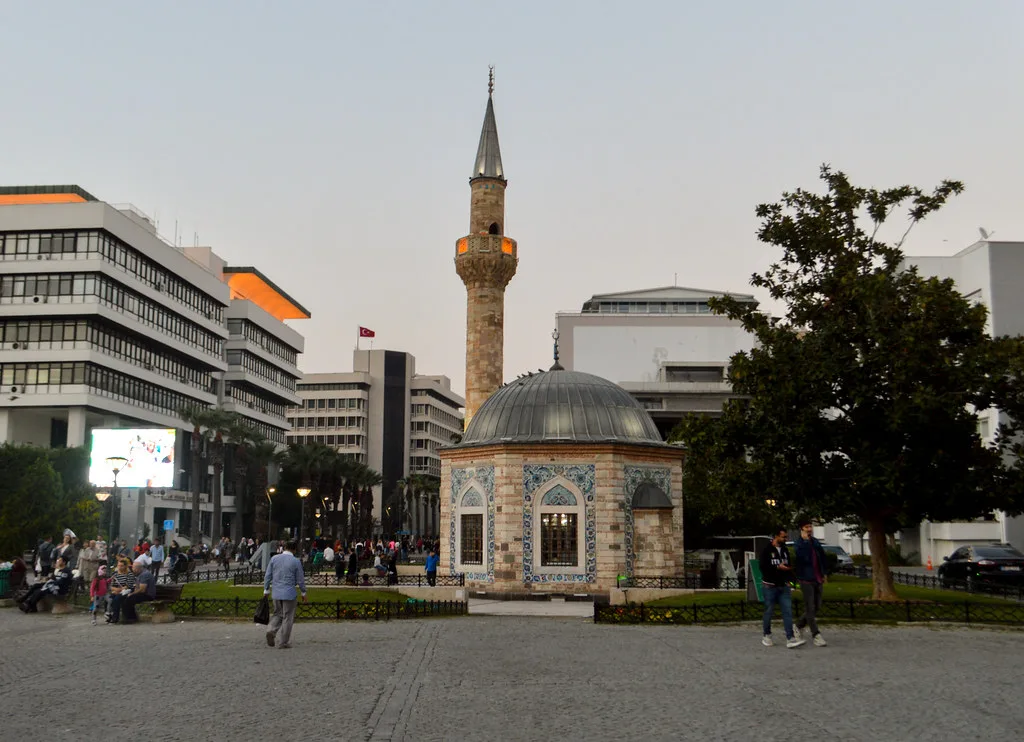
For a fuller walking route through these stops, including the bazaar lanes and the harbour front, use our guide to Izmir Old Town and allow most of a day. Add a stop at one of the city's mosques, such as the Alsancak Hocazade Mosque with its blue dome and tiles, to see the Ottoman layer that survived the fire.
İzmir as a base: distances to Ephesus and other ancient sites
The Archaeological Site of Ephesus is 80 km from the city, about one hour by car, which makes it a straightforward day trip, and the wider Ephesus area also holds the Basilica of Saint John and the Artemision. Çeşme is 87 km away, about an hour by car, and Alaçatı is 76 km, roughly 55 minutes.
Getting around the city itself is simple: there is a metro, tram and several bus routes, and dolmuş minibuses run on a 24-hour basis and cost a little less than taxis. Confirm the current network map at a transport office or on the İzmir Metropolitan Municipality's transport site before relying on a specific line.
Which İzmir sights carry the history?
If you have one day, spend it on the Roman agora and Kemeraltı in the morning, then Konak Square and the Historical Elevator in the afternoon; that covers the Roman, Ottoman and Republic layers without leaving the centre. Add Yeşilova Mound or Old Smyrna only if you have a second day, because each sits away from the waterfront.
If the ancient world is the reason you came, base yourself in İzmir and use the road distances above to plan Ephesus as a separate day rather than trying to combine it with the city sights. Check opening times and transport for each site before you set out, as these vary by season.
Frequently Asked Questions
What was İzmir called before it became İzmir?
The city was Smyrna for most of its history, through the Greek, Roman and Ottoman periods. The modern Turkish name replaced it in 1928 as part of the language reform.
Does this guide cover safety advice for İzmir?
No. Check the UK Foreign, Commonwealth & Development Office travel advice for Turkey before you book, as it carries current safety information.
Sources
Notes for your next Turkey trip
Optional updates when we add or correct a town guide.
You might also like
Continue reading
More guides you'll find useful