Bursa Grand Mosque (Ulu Cami): What to See and Time Needed
The Bursa Grand Mosque (Ulu Cami) is free to enter and sits beside the bazaar quarter. Here is what to see inside, from the twenty domes to the calligraphy.
On this page
The Bursa Grand Mosque (Ulu Cami) is free to enter and needs about one to two hours, which makes it the easiest major sight to fit into a day in central Bursa. It sits in the old centre beside the covered bazaar and the silk market, so it works as the anchor of a walking loop rather than a separate excursion. This guide covers what you see outside and inside, how to reach it, how prayer times shape a visit, and what lies within a short walk.
Where the Grand Mosque sits in central Bursa
Ulu Cami stands at Nalbantoğlu, Ulucami Caddesi No:2, in the Osmangazi district, in the historic core of the city next to the covered market and the silk market, which is why almost every Bursa walking route passes the door. Plan to arrive on foot, because the surrounding streets are the attraction as much as the building. If you are building a wider itinerary, this page on things to do in Bursa fits the mosque into a fuller day.
The building was commissioned by Sultan Bayezid I, known as Yıldırım Bayezid, and completed between 1396 and 1399 as a landmark of early Ottoman architecture. It is the largest mosque in Bursa, a claim that refers to the city rather than the country, so treat any suggestion that it is Turkey's biggest with caution. Later damage reshaped the fabric: restoration followed the 1855 earthquake and the mosque reopened for worship in 1862, and it was damaged again in a fire in 1889 before being restored.
The twenty domes, twelve columns and two minarets
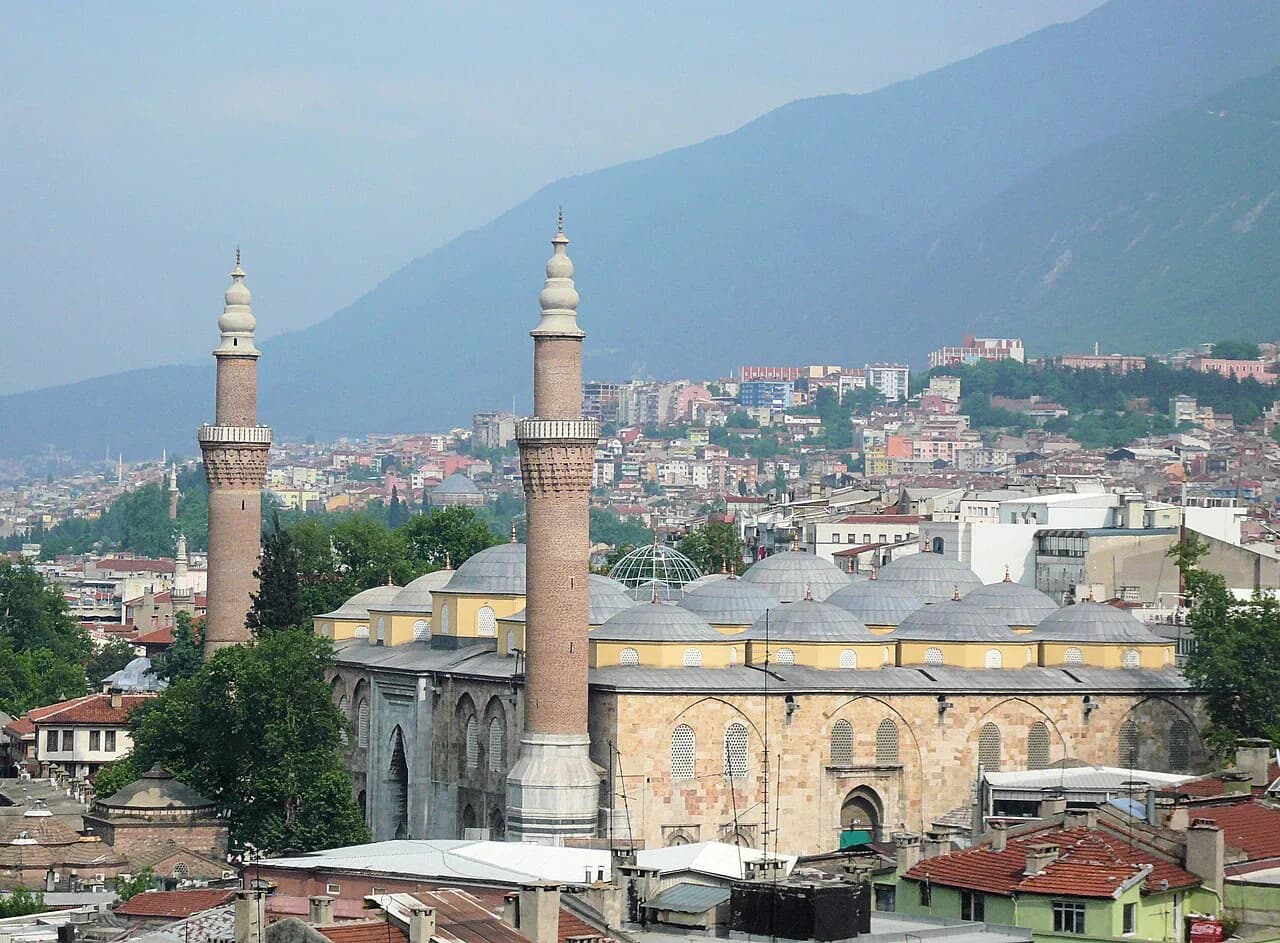
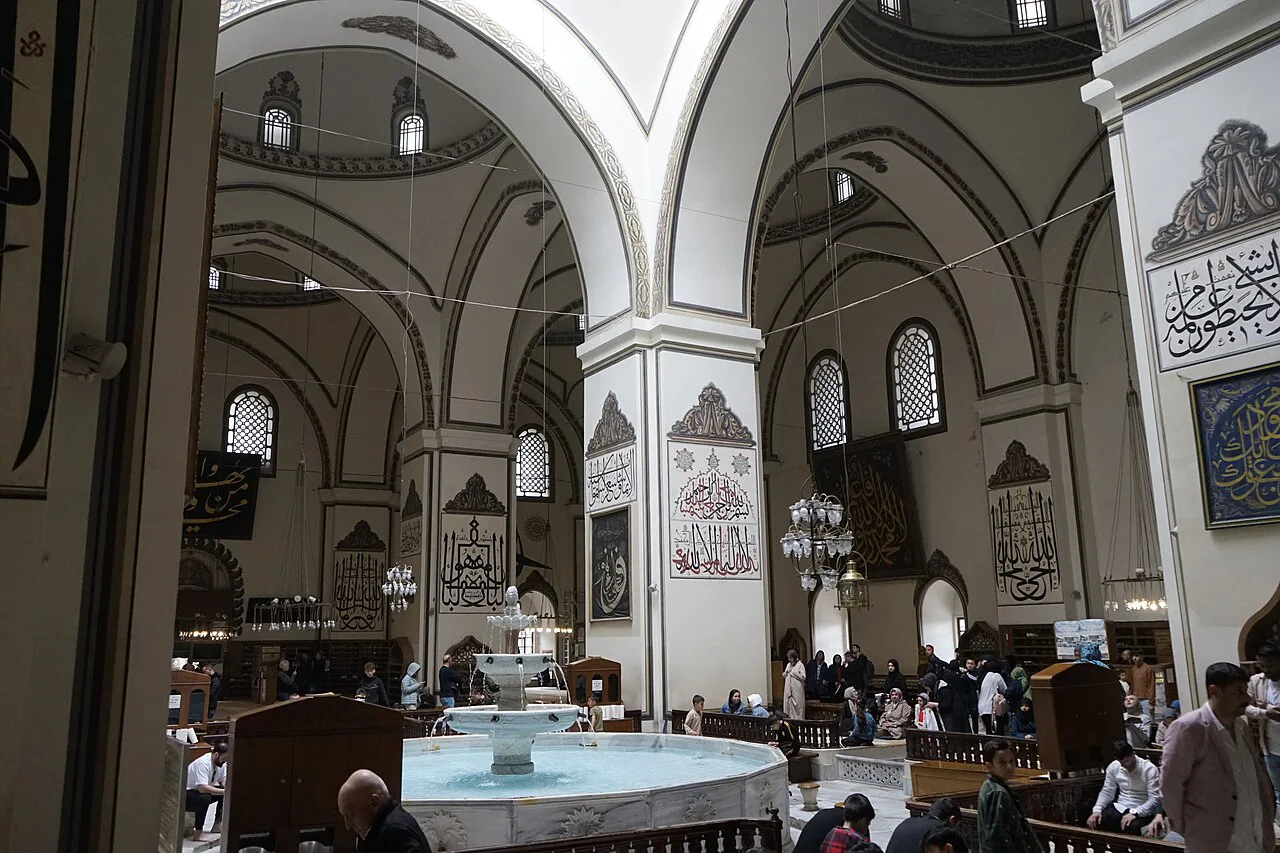
From the street the mosque reads as a long rectangular stone block topped by twenty domes in four rows of five, carried on twelve massive columns, with two minarets rising on the east and west sides. The arrangement follows the Seljuk multi-dome tradition and became a model for early Ottoman mosque design, which is why the roofline looks so different from the single great dome of later imperial mosques. The legend attached to the number is that Bayezid vowed to build twenty mosques after his victory at the Battle of Nicopolis and was advised instead to build one with twenty domes, each standing for a mosque.
The façade carries two entrances on the east and west sides plus an ornamented northern portal known as the Taçkapı. Look for the decorative details on the outer walls before you step in, since the exterior is easy to walk past when the bazaar crowds are heavy. Reading the building from outside first makes the interior layout much easier to follow once you are under the domes.
Inside: the open-domed şadırvan and its pool
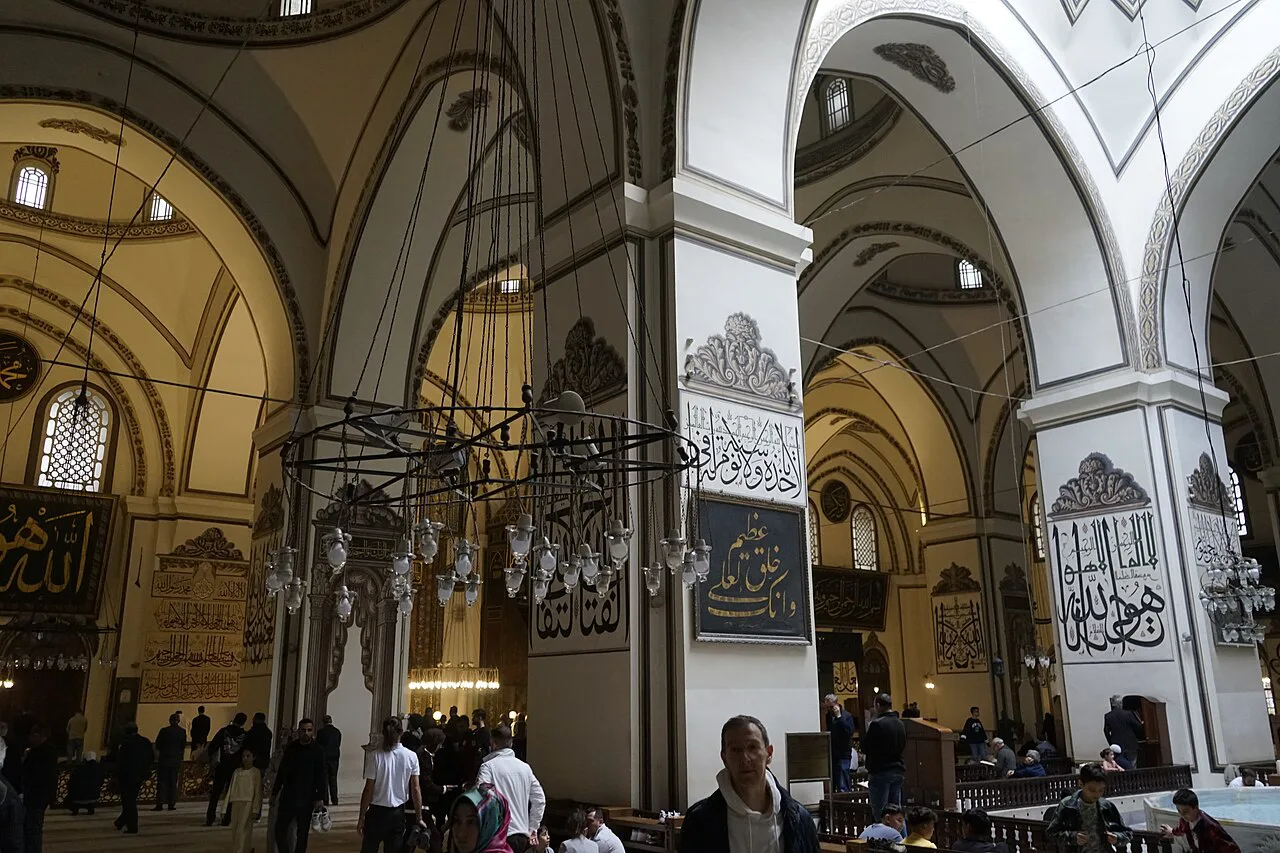
The feature that sets Ulu Cami apart from almost every other Ottoman mosque is the ablution fountain, or şadırvan, placed in the middle of the prayer hall on an eighteen-sided pool rather than in a courtyard outside. The dome above it opens to the sky, now covered with glass, so daylight falls directly onto the water and lifts one corner of an otherwise dim interior. It is the spot most visitors photograph, and the pool is ringed by benches where worshippers rest.
Allow time to walk the full rectangular hall rather than stopping at the fountain, because the space is best understood by moving between the columns. The interior holds intricate woodwork, marble columns and carved inscriptions, and the overall effect is one of space and harmony rather than dense ornament. Photography is the obvious temptation, but keep the prayer area clear when worshippers are present.
The calligraphy panels and the minbar without nails
Walls and columns carry 192 monumental calligraphy panels, executed by more than forty master calligraphers working in thirteen scripts, with verses from the Quran, hadiths and the ninety-nine names of Allah among the subjects. The sheer number has earned the hall the name Calligraphy Museum, and it is the strongest reason to slow down inside rather than treat the mosque as a quick photo stop. The calligraphic compositions date from the eighteenth to the early twentieth centuries, so they tell you about later Ottoman taste as much as about the building's first years.
The walnut minbar beside the mihrab was assembled and carved in the Anatolian Seljuk woodworking tradition, using mortise-and-tenon joints and decoration of geometric patterns and vine motifs without a single nail or glue. A separate account puts the piece at 6,666 components, matching the number of verses in the Quran, which gives a sense of the craft involved. Stand to one side of the mihrab to see how the minbar faces it across the hall.
The Kaaba door covering sent from Mecca
Among the mosque's holdings is the covering of the door of the Kaaba, sent from Mecca to the sultan in 1517, which makes Ulu Cami a place pilgrims and travellers seek out for reasons beyond architecture. It is a reminder that this was a spiritual centre as well as an imperial statement, and that the building has collected objects over centuries rather than being frozen at its completion.
Some travel writing ranks Ulu Cami among the holy places of Islam, placing it after Mecca, Medina, Jerusalem and Damascus. That ranking is not an official designation, so treat it as local pride rather than a fact to repeat as settled.
Getting there from Koza Han and the covered bazaar
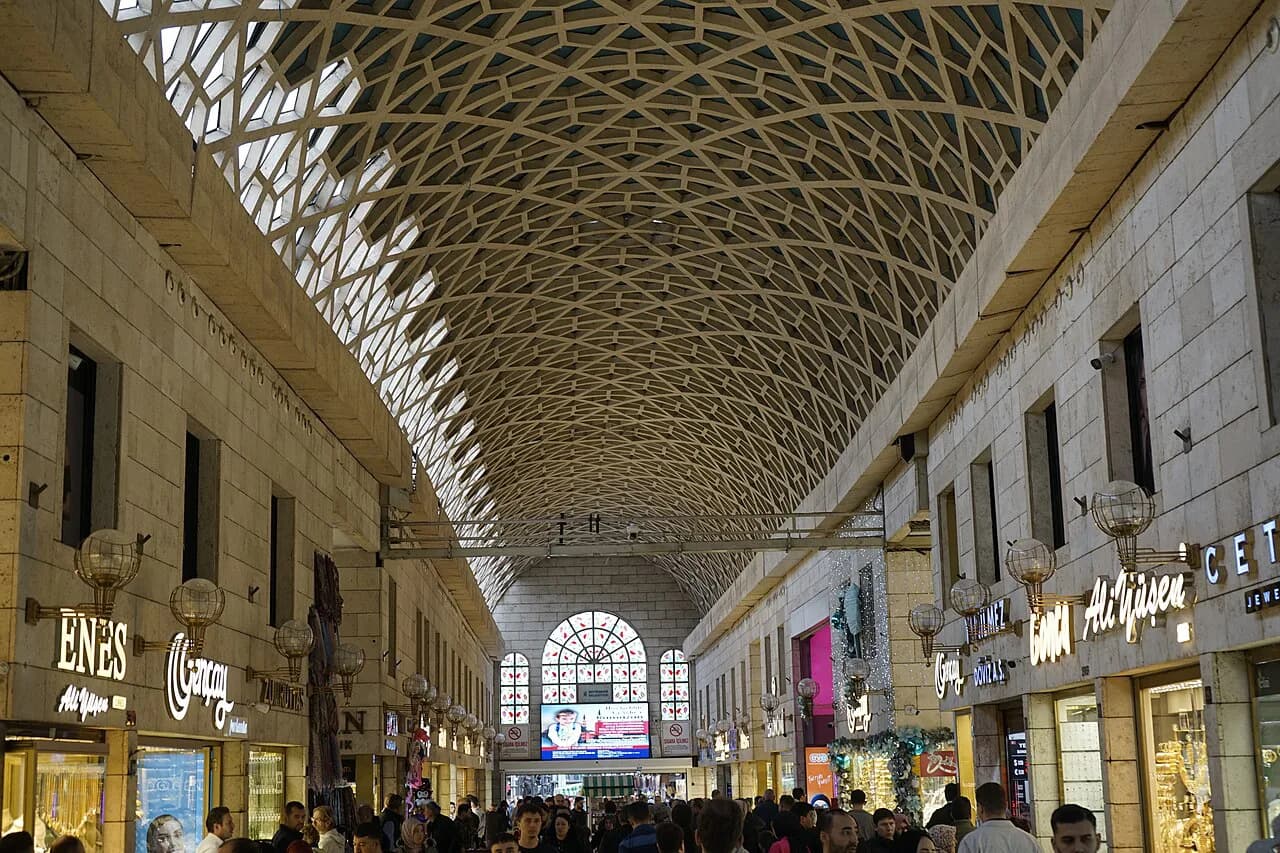
The mosque is a short walk from Koza Han, the historic silk market where you can shop for textiles, and from the covered bazaar that occupies the neighbouring streets. Walk the loop in either direction: bazaar lanes, Koza Han's courtyard, then Ulu Cami, which keeps you in shade for much of the route. The mosque's published address is Ulucami Caddesi No:2 in Nalbantoğlu, and the minarets make a clear bearing through the dense bazaar lanes.
The mosque sits in the dense Osmangazi core, so the last stretch is on foot whichever way you arrive, and the minarets on Ulucami Caddesi make a reliable bearing. Expect the pavements around the entrances to fill up when the bazaar quarter is busiest, and allow a little extra time at those moments.
How long the visit takes
Budget one to two hours for the mosque itself, which covers the exterior, the fountain, a circuit of the calligraphy panels and a proper look at the minbar. Add another hour or two for Koza Han, the silk market and the bazaar streets, because the walking between them is half the point of coming here. Visitors who treat the mosque as a ten-minute stop tend to leave having seen the fountain and missed everything on the walls.
If you are combining the mosque with the Green Mosque and Tomb in Yeşil Mahallesi, split the day rather than cramming: the two sit in different parts of the city and each rewards an unhurried visit. Our guide to the Green Mosque in Bursa covers what to see at that end of town. If you would rather plot the whole city in one place, our things to do in Bursa guide covers the Muradiye Complex and Tophane Park as well.
Opening times, admission and prayer times
A visitor listing shows the mosque open from 08:00 to 21:00 with free admission, which is useful as a planning guide rather than a fixed timetable. It functions as a working place of worship, open from the first prayer of the day until late evening, so access can be adjusted around congregational prayers. Check the day's prayer timetable before setting out, since non-Muslim visitors are advised to keep clear of worshippers during prayer.
There is no charge to enter, although guided tours may carry a fee, so budget only for a guide if you want one.
Dress code and etiquette
Cover shoulders and knees, and women should wear a headscarf, which can often be borrowed at the entrance. Keep voices low near the mihrab and the fountain, and step aside rather than standing in the prayer lines.
Time your visit outside congregational prayers to see the interior at its calmest, and check the day's prayer timetable before setting out so you are not caught in the Friday midday rush. Keep voices low near the mihrab and the fountain, and step aside rather than standing in the prayer lines. Photographing worshippers without asking is the one thing most likely to cause offence.
What is within a short walk
Besides Koza Han and the silk market, the Green Mosque and Tomb, the Bursa City Museum and the Tophane Clock Tower all appear among the mosque's nearby attractions, with the clock tower offering panoramic views over the city. A comfortable half-day links Ulu Cami with the bazaar, Koza Han and the clock tower, leaving the Green Mosque end of town for a separate outing. If you want to fill the rest of your day nearby, these things to do in Bursa make a natural next stop.
If your Turkey trip also takes in Ottoman mosque architecture elsewhere, the Selimiye Mosque in Edirne is the classic single-dome imperial design. Comparing the two is a useful way to see how Ottoman mosque building changed.
Is the Grand Mosque the biggest mosque in Turkey?
No. Ulu Cami is described as the largest mosque in Bursa and one of the finest examples of early Ottoman religious architecture, which is a claim about the city rather than the country. Treat the mosque's importance as architectural and historical rather than a matter of national size.
The same goes for claims that it is the fifth holiest place in Islam: the ranking appears in travel writing without official backing. What is documented is the 192-panel calligraphy collection, the internal fountain and the nail-free minbar, which are reason enough to visit.
Should the Grand Mosque be your first stop in Bursa?
Yes, if you have a single day in the city. Ulu Cami is free, central and compact enough to see properly in one to two hours, and it puts you on the doorstep of Koza Han and the bazaar quarter for the rest of the morning. Come early, dress modestly and leave the Green Mosque for a second outing.
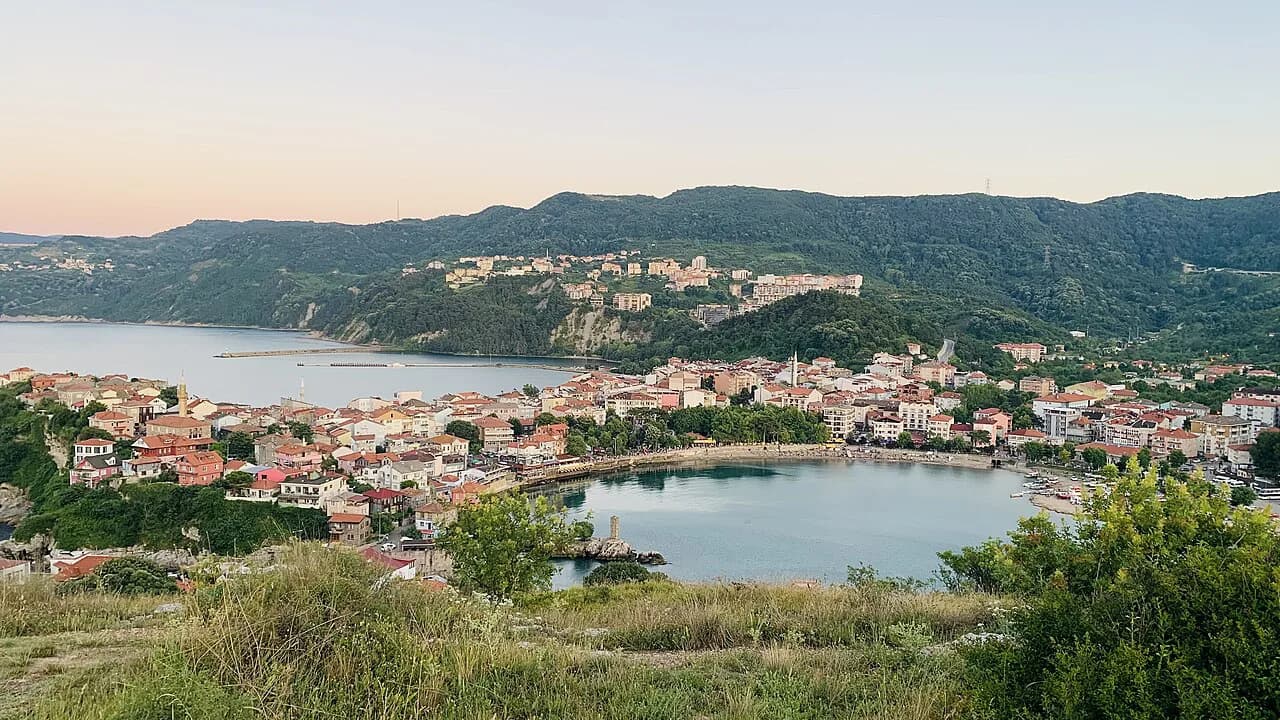
If your route continues along the coast, Amasra shows another side of Turkey's harbour towns. Otherwise, build the day around the mosque, the silk market and a slow lunch, which is how the old centre works best. For the practical details, see İznik, Turkey.
Explore more Bursa guides
Frequently Asked Questions
Do I need a ticket for the Bursa Grand Mosque?
No. Entry is free because the building is an active mosque rather than a ticketed monument. A guided tour, if you book one, is a separate service with its own charge.
What are the opening hours of Ulu Cami?
A visitor listing shows 08:00 to 21:00, but the mosque is an active place of worship, so access can be adjusted around the five daily prayers. Check the day's prayer timetable before setting out, and avoid the periods around congregational prayers, especially Friday midday.
Can non-Muslims go inside the Grand Mosque?
Yes. Visitors cover shoulders and knees, women wear a headscarf, shoes come off at the entrance and non-Muslims are advised to stay clear of worshippers during prayer.
How far is the mosque from Koza Han?
It is a short walk. Koza Han and the covered bazaar occupy the streets immediately around Ulu Cami, so the three form one continuous stroll through the old centre.
Is the Grand Mosque the biggest mosque in Turkey?
No. It is described as the largest mosque in Bursa and one of the finest examples of early Ottoman religious architecture, which is a claim about the city rather than the country.
Sources
Notes for your next Turkey trip
Optional updates when we add or correct a town guide.
You might also like
Continue reading
More guides you'll find useful