Hadrian's Gate, Antalya: What to See at Üçkapılar in Kaleiçi
Hadrian's Gate, or Üçkapılar, is the Roman triumphal arch at the entrance to Kaleiçi in Antalya. Here is what you see, how long it takes and what is nearby.
On this page
Hadrian's Gate is a ten-to-fifteen-minute stop, not a half-day monument: you walk through it, look up at the carvings and carry on into Kaleiçi. It is a working crossing between the modern city and the old town, so it costs nothing to pass and fits easily into any walk through the district. This guide covers what Hadrian's Gate is, which details are worth pausing for, how the towers differ, and what to pair with it nearby.
What Hadrian's Gate is and where it stands
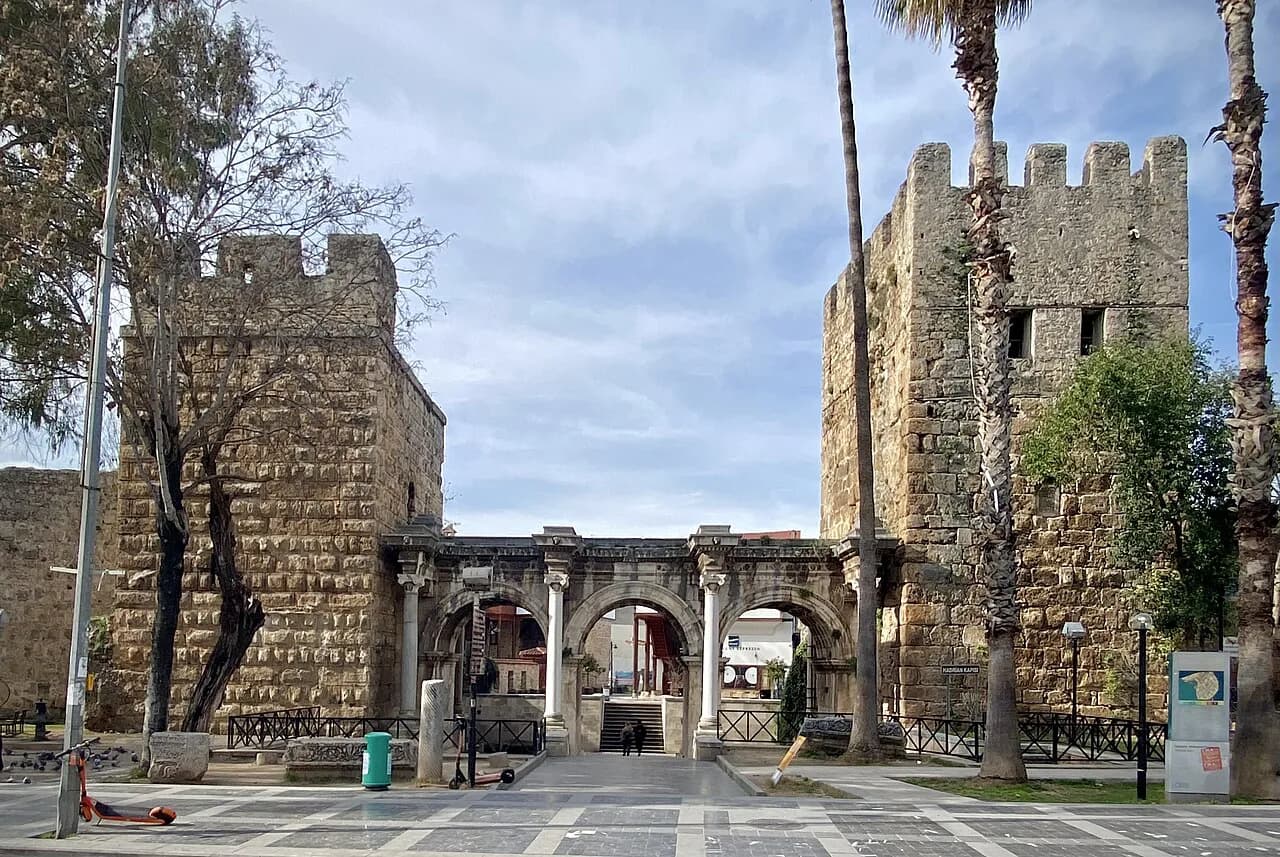
The gate sits at the entrance to Kaleiçi in the Muratpaşa district of Antalya, and locals know it as Üçkapılar, the Three Gates. It was built as a monumental triumphal arch in the city walls to honour the Roman emperor Hadrian's visit in 130 AD. The structure is largely white marble, apart from the column shafts, and it survives as one of the best-preserved historic buildings in the city.
It stayed behind the city walls for centuries, which sheltered it, and it was rediscovered in 1882 when the remains of those walls were removed. A comprehensive restoration followed in 1959. Treat the gate as the seam between the Roman city of Attaleia and the Ottoman street pattern you walk into on the other side.
Why it is called Üçkapılar, the Three Gates
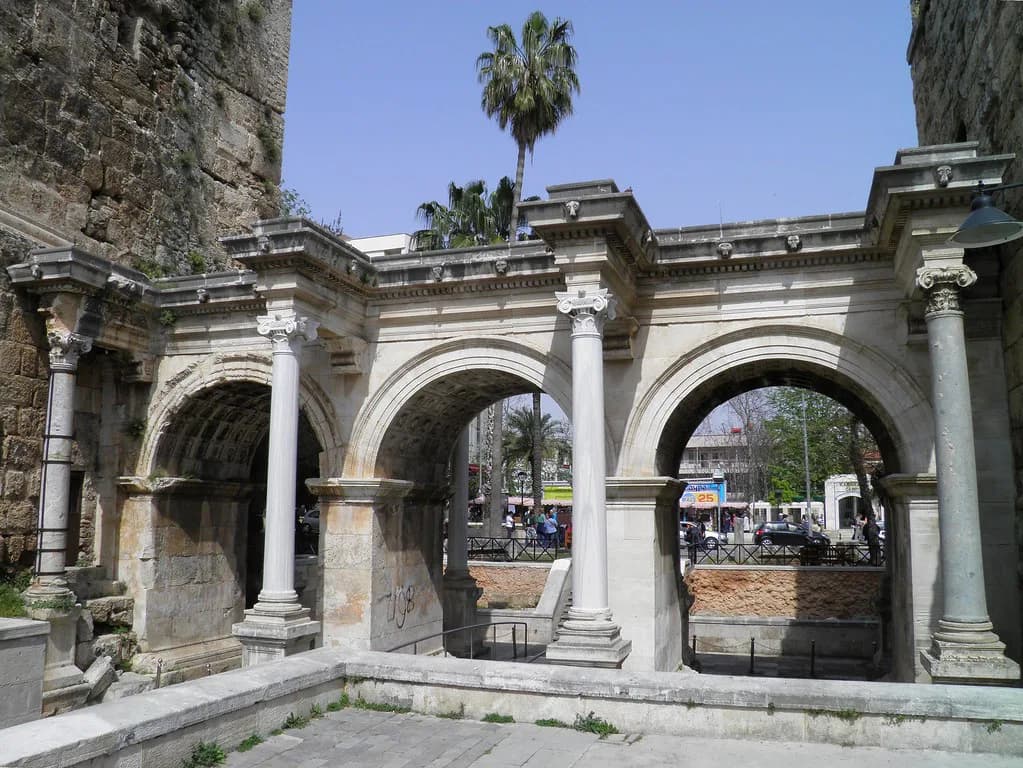
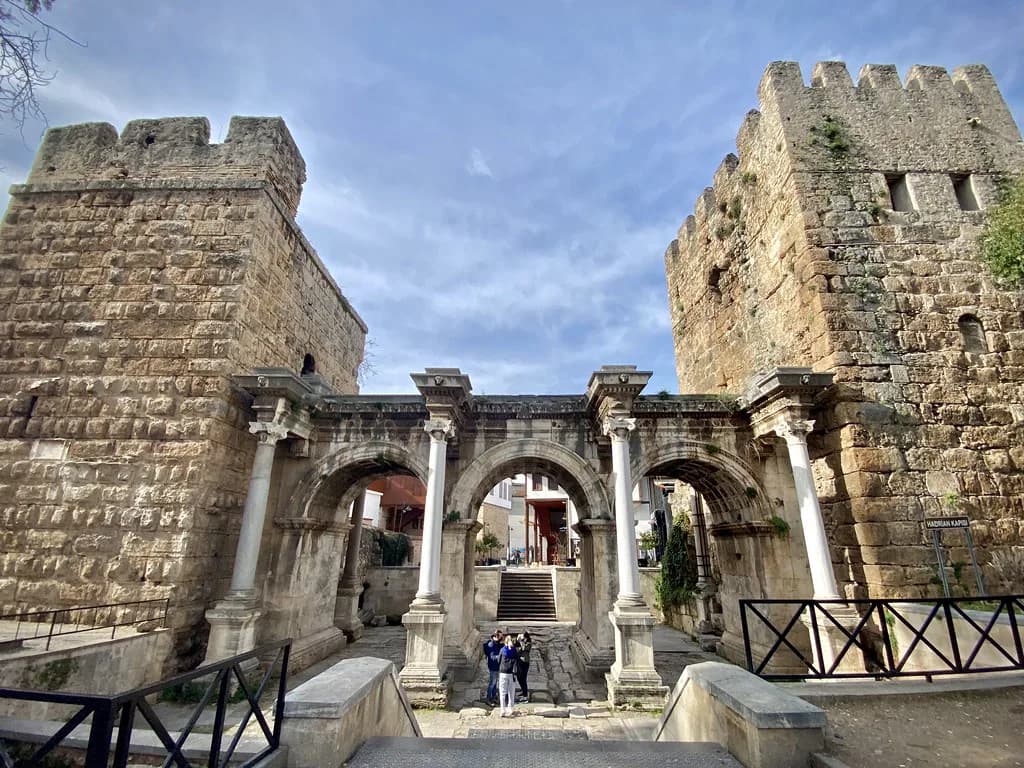
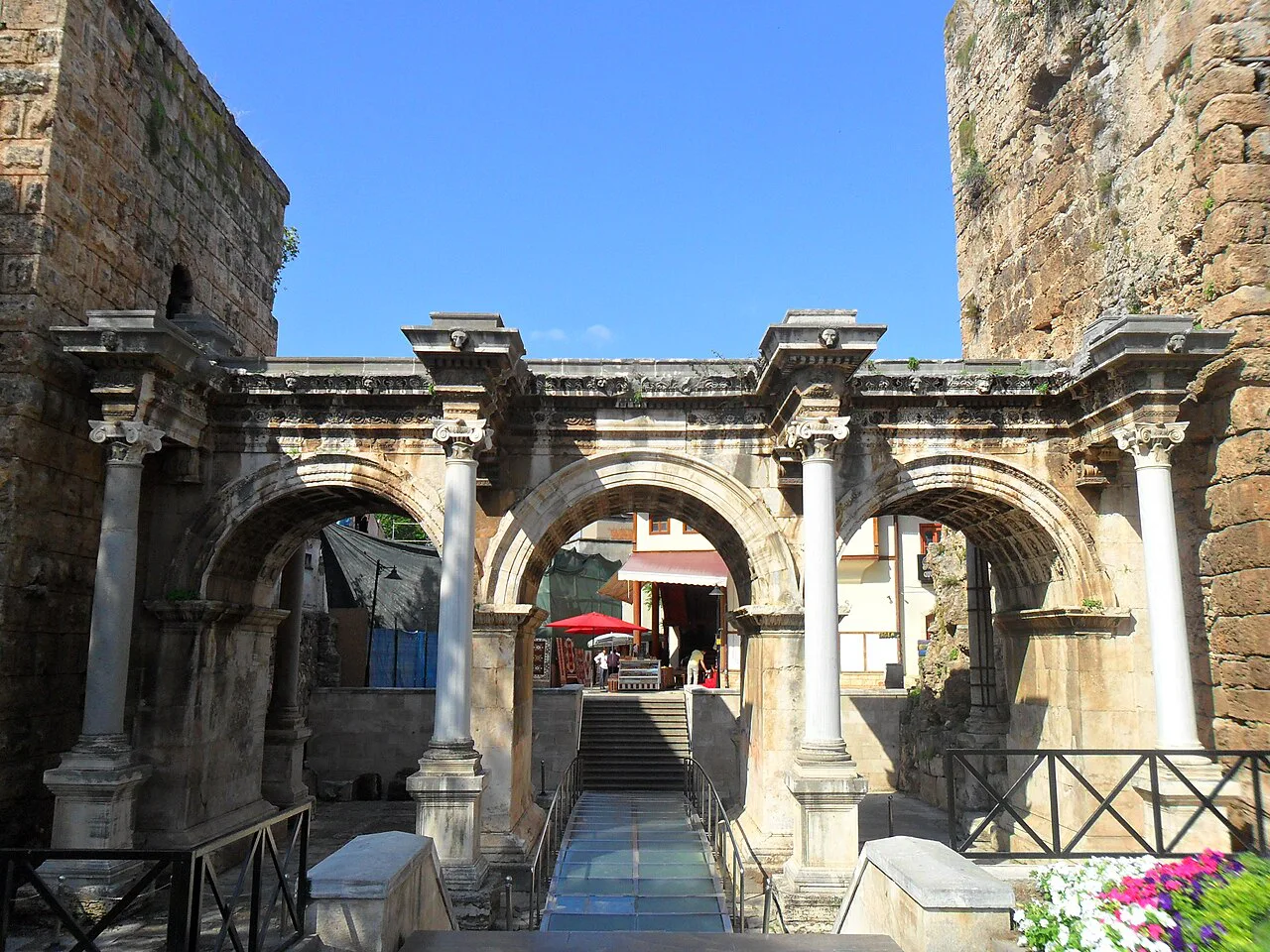
The name is literal. The gate consists of three symmetrical arches, each 4.15 metres wide and 6.18 metres high, and the gate section rises to about eight metres. Walk through the central arch and you are standing in the same opening that carts, animals and people have used for centuries as the main way into the walled town.
What to look for up close
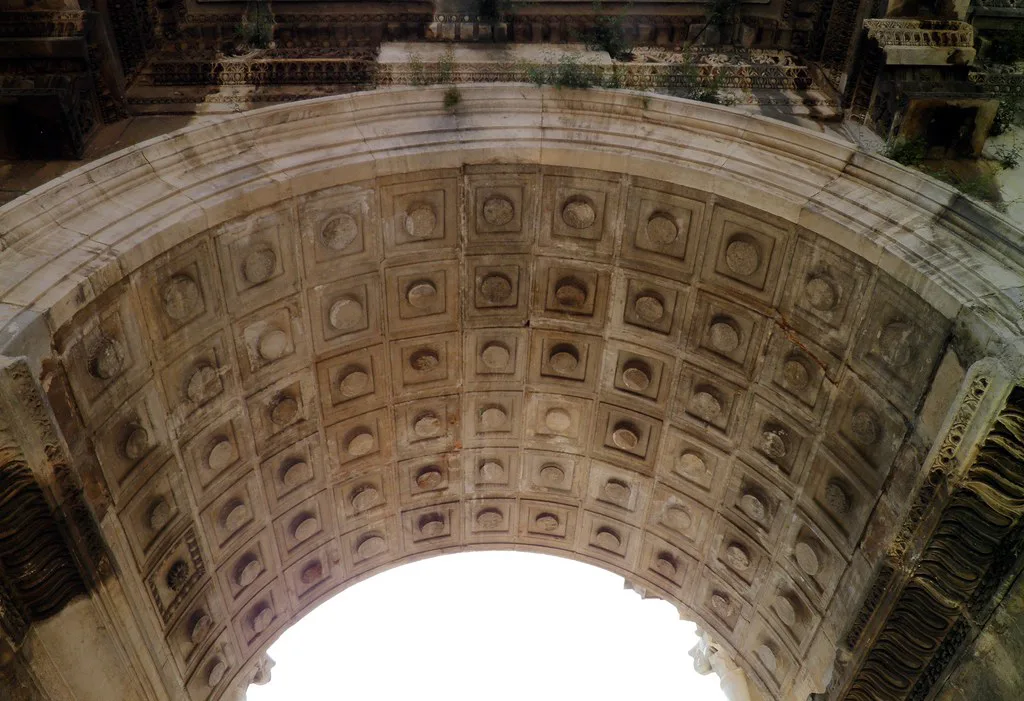
Most visitors photograph the facade and move on, but the detailing is overhead. The coffered ceiling panels carry daisy-like floral patterns alongside fruit and leaf motifs, which are read as symbols of the crops grown around Antalya. Stand inside an arch and look straight up before you continue.
On the cornice you can pick out lion-head figures, and the whole face is covered in reliefs and carvings rather than left plain. Give yourself a few minutes on each side of the gate: the modern-city approach shows the arch framed by shops and traffic, while the Kaleiçi side reveals it against the old street line.
The two towers: Roman south, Seljuk north
The towers either side of the gate do not match, and that is the point of looking at them. The structure's towers reach roughly 15 metres, with the southern tower dating from the Roman period. The northern tower's lower section is ancient, while its upper section was built during the reign of the Seljuk Sultan Alaeddin Keykubad I.
Read the gate as a palimpsest: a Roman arch, a Seljuk addition above it and a twentieth-century restoration holding it together. Once you have spotted the change in stone and style on the northern tower, the rest of Kaleiçi's mixed fabric makes more sense.
Seeing the gate lit at night
Hadrian's Gate has been illuminated under a project run by the Antalya Governor's Office through the General Directorate of Cultural Heritage and Museums, with the budget covered by the Governor's Office. The lighting brings out the carvings and ceiling panels after dark in a way daylight flattens. There is no published schedule for the illumination, so treat an evening visit as a bonus rather than a fixed appointment.
A sensible pattern is to cross the gate by day, explore the old town, then return along the same street after dinner to see the marble under the lights. The gate remains an open crossing, so the return costs you nothing but the walk.
How long to allow and how to fold it into a Kaleiçi walk
Ten to fifteen minutes covers the gate itself: three arches, the ceiling panels, the lion heads and a look at both towers. The stop becomes an hour or more once you continue into the old town, where narrow lanes, courtyard houses and bazaar streets reward wandering. The gate is the natural beginning or end of a circuit rather than a destination in its own right.
Come in the morning or late afternoon to avoid the middle of the day, when the marble throws hard shadows and the lanes fill up. The gate faces the modern city, so it is easy to combine with a walk down to the harbour and back up through the old streets.
Getting there on foot from the old town and harbour
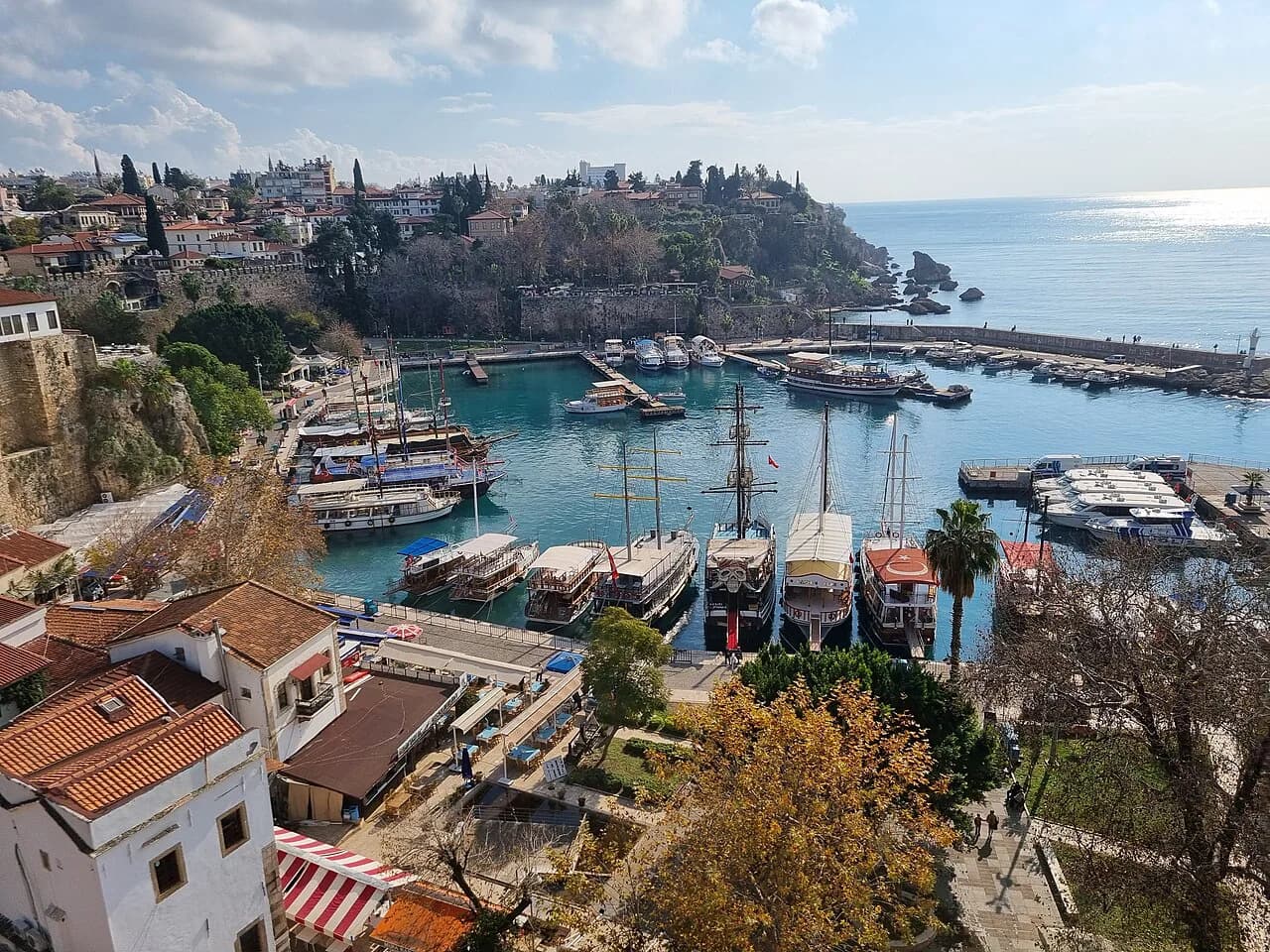
The gate stands on the landward edge of Kaleiçi, so you reach it on foot from anywhere in the old town. From the harbour, climb through the lanes towards the city side and the arch appears where the pedestrian street meets the old wall line. Coming from the modern city, walk towards Kaleiçi and the gate is the obvious entry point.
Because it is a public thoroughfare rather than a walled site, there are no gates to queue at and no set route through it. Wear shoes that cope with uneven stone, and keep an eye on traffic on the modern-city side, where the arch opens onto a busy street.
Nearby sights to pair with the gate
The Antalya Archaeological Museum is the natural follow-up if you want context for the region's Roman sculpture and finds, and it sits outside the old town, so plan it as a separate taxi or tram leg. Inland from the city, the Düden Waterfall drops over the cliffs and makes an easy half-day contrast to the stone lanes.
Hadrian's Gate also appears as a stop on guided old-town tours that pair the Roman arch with a Turkish lunch and a ride on the Tünektepe Teleferik cable car. Booking a tour buys you context and transport; walking it yourself buys you time to linger in the arches.
For something quieter, Kurşunlu Waterfall and its surrounding nature park lie outside the city and suit a shaded afternoon. Closer in, Karaalioğlu Park gives you sea views and a breather between the old town and the museum quarter.
Tickets and opening hours for a public crossing
No ticket or opening time applies to Hadrian's Gate as an attraction: it functions as a crossing point linking the historic fabric with modern life, and you walk through it as part of the street. That is why there is nothing to book in advance.
Check the illumination and any restoration work locally before an evening trip, since no schedule is published. If the lights are off, the gate still reads well by day, so nothing is lost.
Is the gate worth the detour?
Yes, if you are already going into Kaleiçi, because the gate costs nothing and takes ten to fifteen minutes. It is not worth a special journey across the city on its own, but as the doorway to the old town it earns its place at the start of a walk.
Go once in daylight for the arches, ceiling panels and lion heads, and once after dark if the illumination is running. Then carry on into the lanes, down to the harbour or out to the museum, and let the gate be the hinge of the day rather than the whole of it.
Explore more Antalya guides
Sources
Notes for your next Turkey trip
Optional updates when we add or correct a town guide.
You might also like
Continue reading
More guides you'll find useful