Kaymaklı Underground City: What to See, Tickets and Time Needed
Plan a visit to Kaymaklı Underground City in Cappadocia: what the tunnels and rooms hold, how long it takes, opening hours, tickets and how to get there.
On this page
Kaymaklı Underground City is the underground settlement to pick if you want a compact, room-by-room look at how Cappadocia's communities lived below ground, and the Cappadocia E-pass listing gives a visit of about an hour. It sits beneath the village of Kaymaklı in Nevşehir province, roughly 21 km from Nevşehir city centre, and the carved passages are tight enough that anyone uneasy in enclosed spaces should read the warnings before buying a ticket. This guide covers the layout inside, the published hours and last entry, what entry costs, how long to allow, transport options and the nearby sights worth pairing with it.
What Kaymaklı Underground City is
Kaymaklı is one of the underground settlements carved into the soft tuff rock of Cappadocia, and the Cappadocia E-pass listing places its origins in the Hittite period before it was extended during the Roman and Byzantine eras. It is not a ruin you look at from a path: you go down into a working sequence of corridors, chambers and storage areas cut on several storeys. For an overview of how it fits alongside the region's other sights, see Things to Do in Cappadocia.
Its address is Camii Kebir Mah. Eşref Ayhan Cad. No:46 in Kaymaklı, and the entrance sits within the modern village rather than in open countryside. That matters when you plan transport, because you arrive in a working Anatolian village and walk to the site, not to a remote car park in a valley.
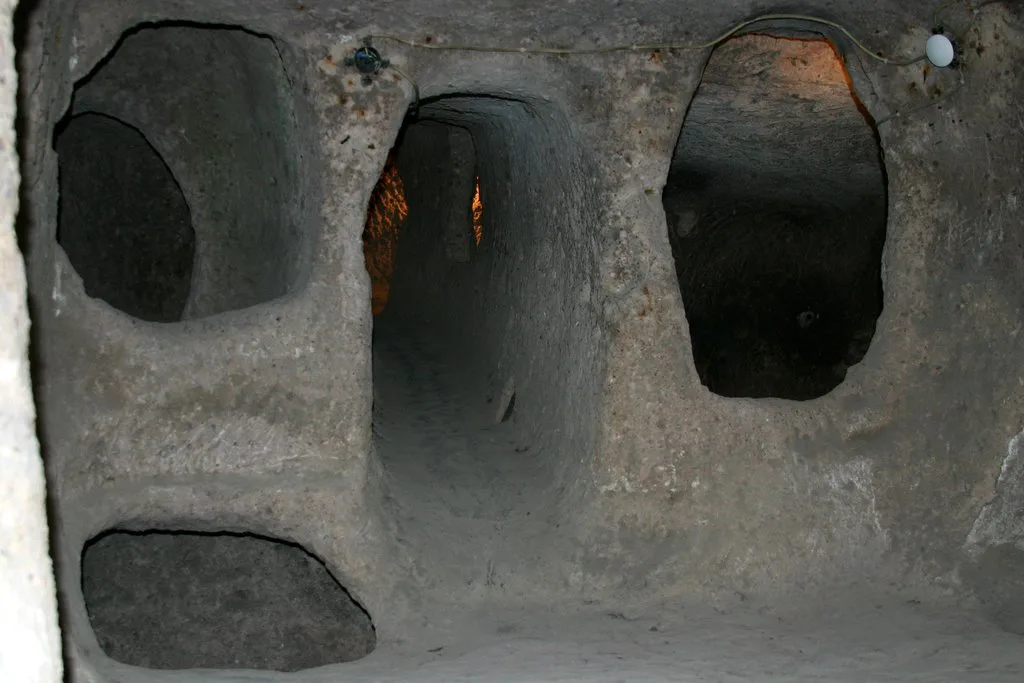
The layout inside: corridors, rooms and bolt stones
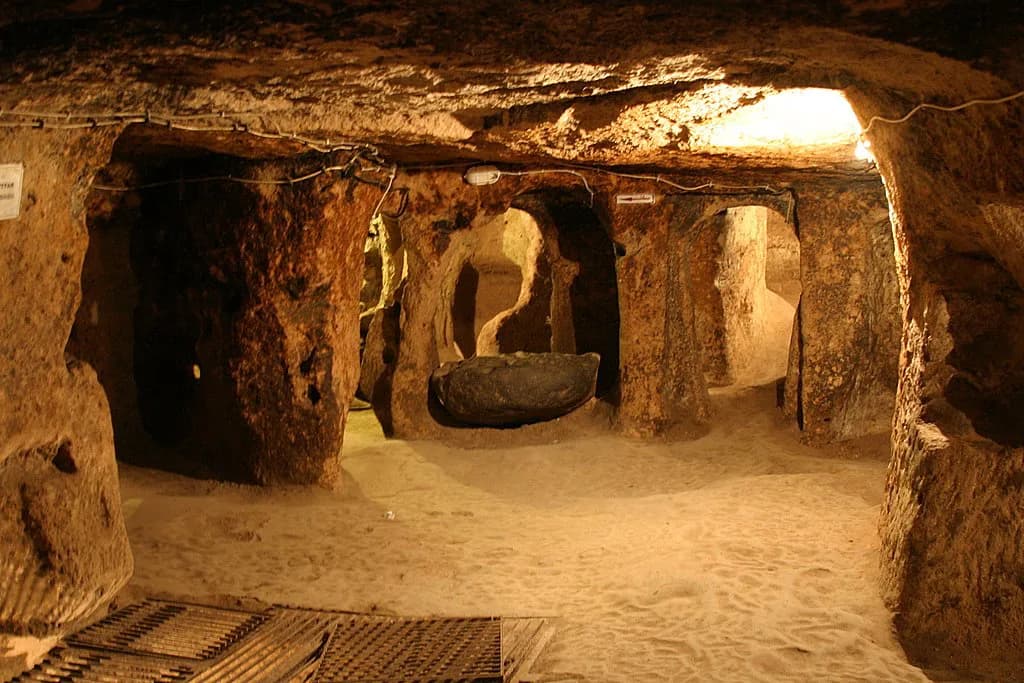
Inside, rooms and halls connect through narrow corridors, and the Cappadocia E-pass listing describes wine tanks, water cellars, a kitchen and food warehouses, ventilation shafts and water wells. You also pass a church, which shows that the settlement served more than storage alone.
The detail that stays with most visitors is the large bolt stones, discs that, as the Cappadocia E-pass listing describes, could be rolled across a doorway and secured from the inside to shut the settlement off from danger outside.
If you have already seen Derinkuyu, you will recognise the vocabulary here: ventilation shafts, storage chambers and the same defensive design logic, on a smaller and easier-to-follow circuit.
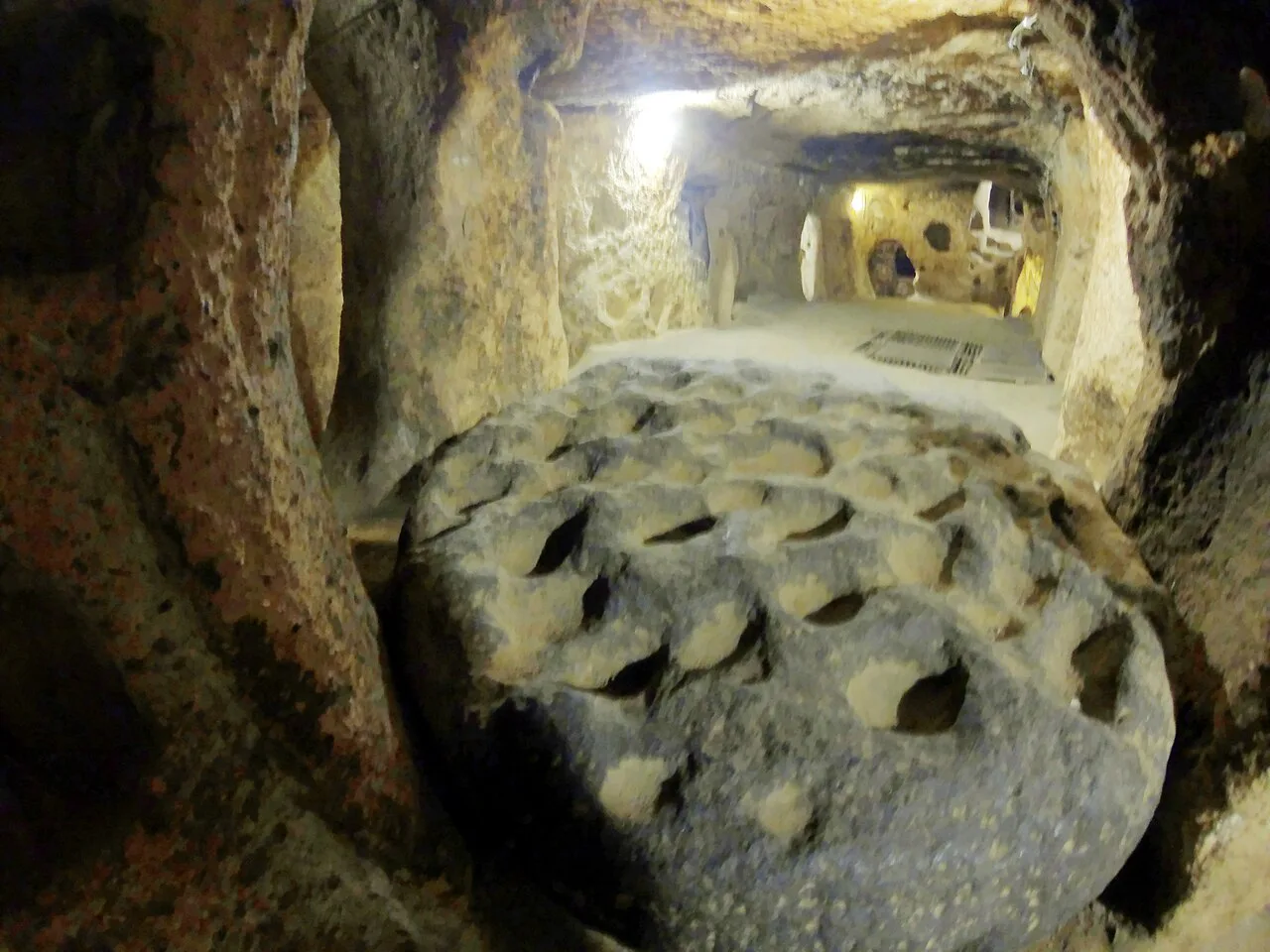
How deep and how many levels you actually walk
Treat the floor count and depth figures you see quoted with some caution, because they vary. One operator describes walking down five levels, while the Cappadocia E-pass listing says the city has eight floors; a travel-pass article puts it at more than 85 metres deep.
What you feel is a low, narrow passage rather than a deep drop: stooped sections, single-file stretches and steps where you wait for people coming the other way. For a comparison with the region's other excavated settlements, read the guide to Cappadocia underground cities.
Opening hours and last entrance
The Cappadocia E-pass listing gives opening hours of 08:00 to 17:00 every day, with the last entrance at 16:00. Plan around that last-entry time rather than the closing time, because arriving after 16:00 leaves no way in. The same listing carries the schedule that applies when you book, so check it against your day before you set out.
Tickets, the pass and prices
The Cappadocia E-pass listing gives the normal ticket value as €13 and includes entry to Kaymaklı for pass holders who reserve through the E-pass customer panel and scan a QR code at the gate. Euro prices are not the only variable here: Turkish lira rates at the ticket window move faster than any published figure, so treat any number here as a reference rather than a guarantee.
A pass only pays off if you plan to combine several paid Cappadocia sights in the same trip, so tot up the entries you genuinely want before buying. Buy at the gate or reserve through the pass operator, and bring photo ID for any child using the pass, as the listing states.
How long a visit takes
Allow around one hour inside, which is the duration the Cappadocia E-pass listing gives for a Kaymaklı visit. The circuit is short but slow in places, with single-file passages around other visitors.
Add buffer time for the ticket queue before you descend and for the village road back out. If you are pairing Kaymaklı with Derinkuyu on the same day, budget the two visits separately; the ticket queue and the descent make rushing them back to back unrealistic. Ticket prices and closing times can change, so check them before you travel.
Getting there from Nevşehir, Göreme and beyond
Kaymaklı lies about 21 km from Nevşehir city centre, and the entrance is on the village street given above, so a car or taxi drops you within a short walk. Dolmuş minibuses run on local routes in Cappadocia rather than to a published schedule, so ask at your accommodation or the Nevşehir otogar for the current Kaymaklı service and where it stops in the village.
From Göreme, most people come as part of an organised green route or by hiring a car, because Kaymaklı sits south of the main Göreme–Nevşehir corridor. Use the Cappadocia map to judge the drive between the villages before you commit to a self-drive day.
Guided day tours sometimes bundle Kaymaklı with the Ihlara Valley and the Göreme Open Air Museum approach from the north, which suits travellers without a car but fixes your time at each stop. If you want an unhurried hour below ground, self-drive or taxi gives you control over the clock.
Who should skip it
The Cappadocia E-pass listing advises against the visit for people with claustrophobia, heart ailments, lower back pain or difficulty walking, and says those visitors enter at their own risk. Take that seriously: this is not a site you can enjoy from a bench at the back.
The passages are low and narrow, with steps between levels, so anyone who struggles with uneven footing or crouching will find it a strain.
What to pair with Kaymaklı
Derinkuyu Underground City is the natural pairing: it lies further south on the same road and offers the other big underground circuit, so you can see both and compare the bolt stones and ventilation systems with fresh eyes.
Northwards, the Göreme Open Air Museum fills a half-day with its rock-cut churches and painted interiors, among them the Dark Church and the Tokalı Church. Going from the cool, enclosed tunnels at Kaymaklı to the open valley at Göreme makes a sensible split across one day.
If you have a spare afternoon, the Zelve Open-Air Museum and the Ihlara Valley give you two more very different looks at how communities used the rock, one abandoned village and one green gorge walk.
Heat, crowds and timing within the day
The underground levels stay cool while the surface bakes, which makes Kaymaklı a useful stop in the middle of a hot Cappadocia afternoon. Carry a light layer if you feel the cold, and wear shoes with grip for the worn stone steps.
If you are driving, aim to be inside before the tour buses build up rather than queueing behind them.
Kaymaklı or Derinkuyu?
Choose Kaymaklı if you want the shorter, more compact circuit and plan to be in the Nevşehir area anyway; choose Derinkuyu if you want the longer descent and have a full half-day to give it. Either way, confirm the day's opening hours and last entry before you travel, and decide on the pass only after adding up the entries you will actually use.
Explore more Cappadocia guides
Frequently Asked Questions
Who lived in the underground city at Kaymaklı?
The Cappadocia E-pass listing places the origins of the settlement in the Hittite period, with later carving and expansion during the Roman and Byzantine eras. It describes rooms, storage areas and a church built for a resident community, though the listing does not set out a full history of who occupied the site at each stage.
Can you visit Derinkuyu Underground City as well?
Yes. Derinkuyu is a separate underground settlement further south on the same road and is commonly visited on the same day as Kaymaklı. Check its own opening hours and ticket arrangements before you go, since they are published separately from Kaymaklı's.
Does a Müzekart cover entry to Kaymaklı?
The published information for Kaymaklı sets out entry through the Cappadocia E-pass and does not state Müzekart validity for the site. Confirm at the ticket window or on the official museum listing before relying on a Müzekart.
Sources
Notes for your next Turkey trip
Optional updates when we add or correct a town guide.
You might also like
Continue reading
More guides you'll find useful