The Evil Eye in Turkey: Nazar Meaning and What to Look For
The nazar, Turkey's blue evil eye, is a charm believed to deflect envy and misfortune. Here is what it means, how it is used and what to look for.
On this page
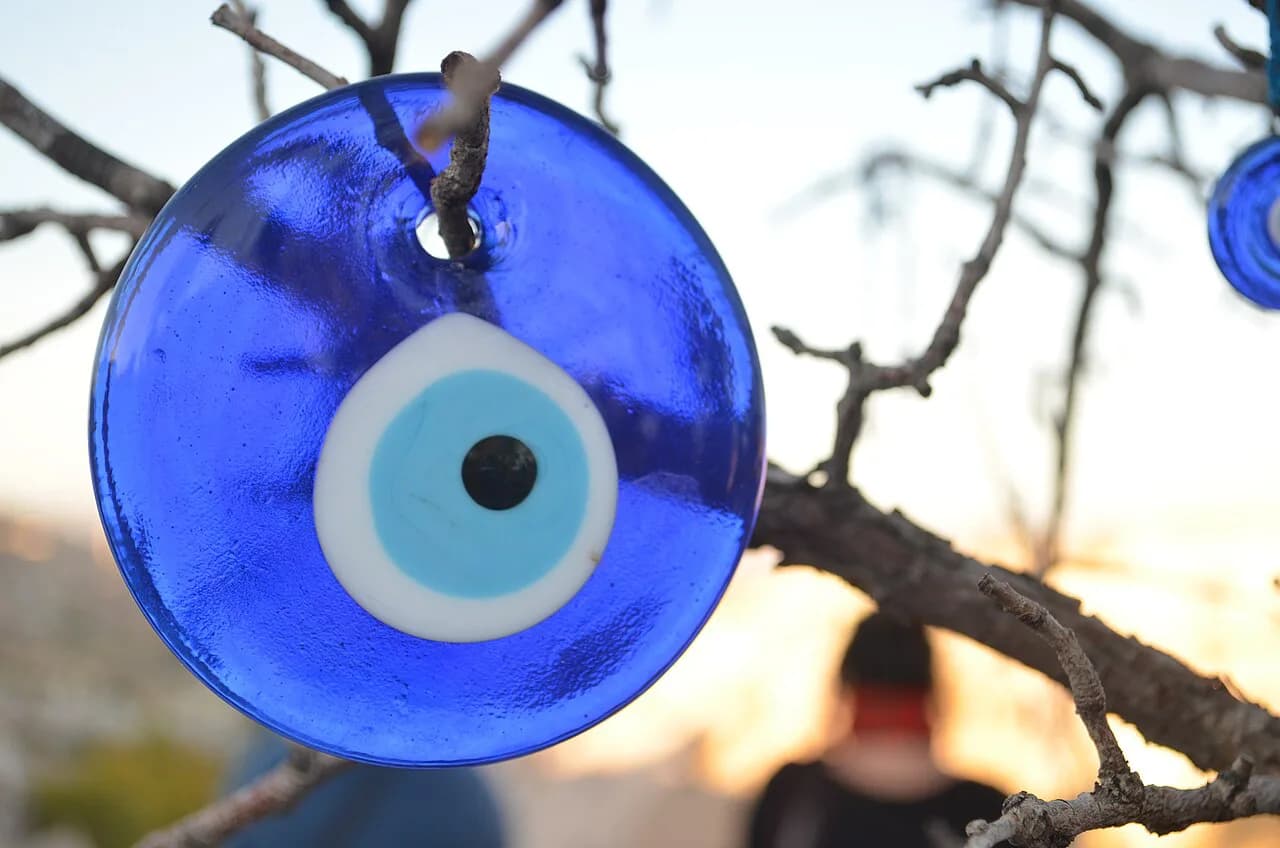
The evil eye in Turkey is the nazar: a belief that envy or admiration can bring harm, and a blue glass amulet called the nazar boncuğu carried or hung to deflect it. You will see the bead in bazaars, on shop doors, in car windows and pinned to children's clothes, usually as a blue circle with a white and dark centre that looks like an eye. This guide covers what the belief means, the phrases Turks use alongside it, the other protective objects sold next to it, and how to tell the Turkish bead from the Greek mati.
What the evil eye means in Turkey
In Turkish belief, the nazar is a force set off by jealousy or envy that can harm a person, their animals or their possessions. The word comes from the Arabic naẓar, and the belief is still widespread in Turkish society rather than a folk curiosity kept for tourists. That matters for visitors because the amulet is a working object in daily life, not just a souvenir design.
References to the evil eye appear in ancient Greek and Roman texts and in Ugaritic material from the Late Bronze Age, and the idea is shared across many Mediterranean cultures rather than belonging to one of them.
Why the nazar is blue and what the eye shape stands for
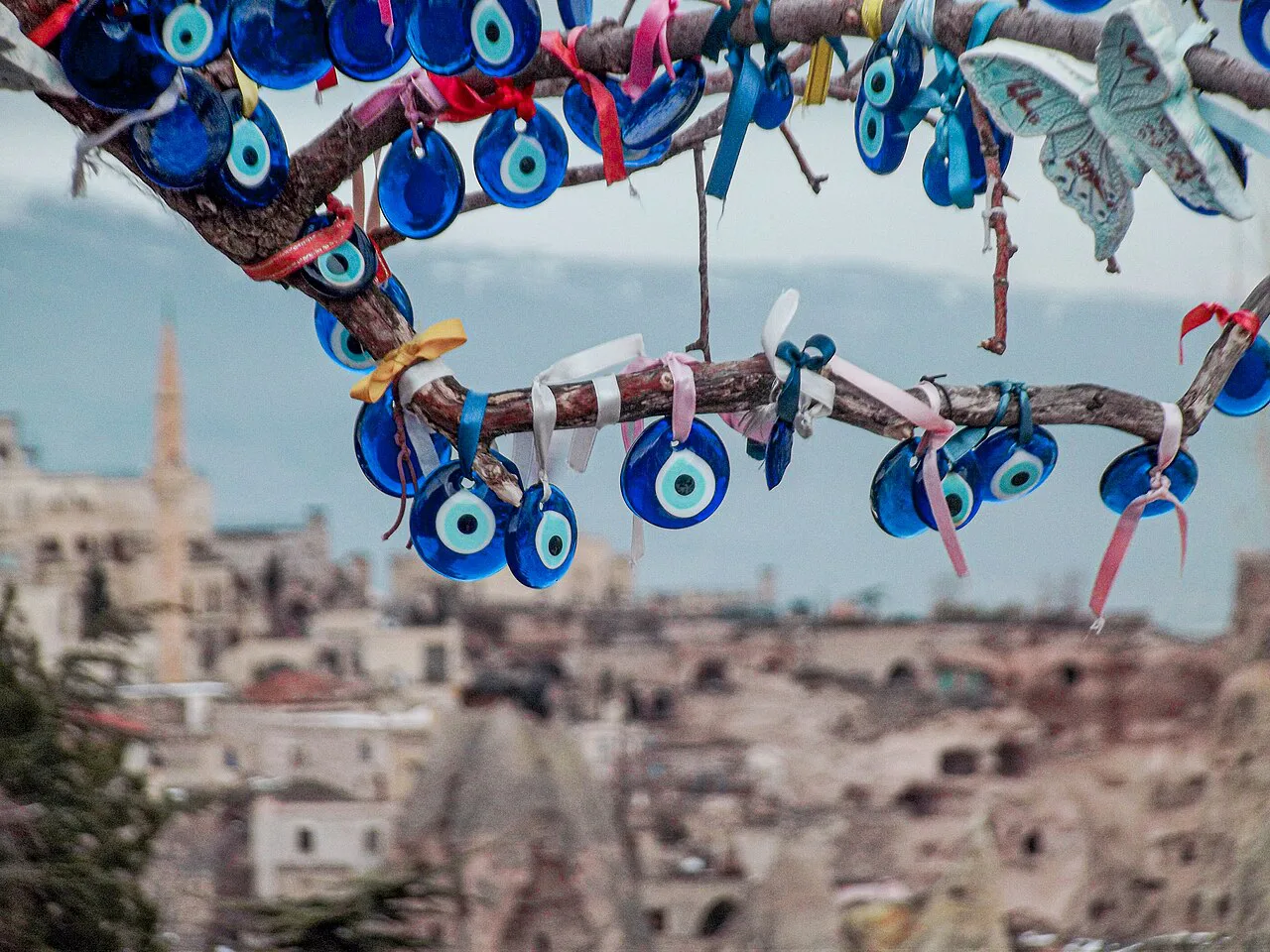
The classic nazar boncuğu is a circle or teardrop in blue, white and black arranged as an eye. Blue is the dominant colour because it is believed to act as a shield that deflects or absorbs negativity, which is why the charm is so often a deep cobalt rather than any other shade. The eye shape gives the object its job: it looks back at the envy rather than at you.
Where should you hang a Turkish evil eye? Homes usually hang the bead on a wall or above a doorway, shops fix it over the entrance, and drivers suspend one from the mirror or fix it to the dashboard. The purpose is to protect the building, vehicle or people inside, so place it where it faces outward rather than tucked away in a room.
What do you say when you compliment a Turkish child? Say maşallah. The word is used precisely so that admiring a child or their belongings does not attract the evil eye, and many people say it as a reflex.
Is the Turkish evil eye bead the same as the Greek mati? The shape and blue palette are essentially the same, and both are sold as protection against envy. The Turkish name is nazar or nazar boncuğu, and the Greek name is mati.
In Turkey, people with blue eyes are considered especially exposed to the evil eye themselves, and also capable of attracting it by looking at others. Some take extra precautions for that reason, which explains occasional remarks a blue-eyed visitor may hear from a stranger, often followed by a protective phrase rather than an insult.
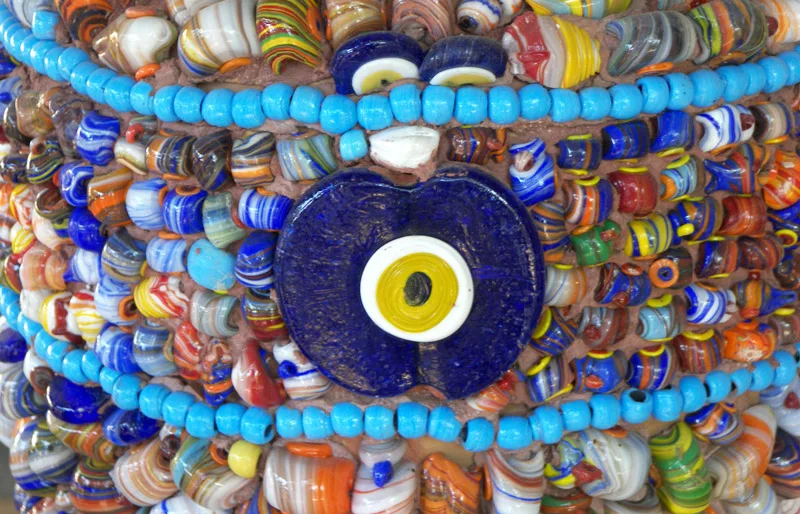
Nazar boncuğu: the glass bead visitors see most
The nazar boncuğu is the item you will actually be offered: a glass bead pinned to a child's clothing, hung on a wall, suspended in a car or fixed above a shop entrance. It also turns up worked into textiles, home decorations and cheap jewellery, where the eye is printed or enamelled rather than blown in glass.
In the wider set of protections it sits alongside red ribbons, the hamsa or Fatma's Hand, motifs woven into Turkish carpets, and muska necklaces carrying Quranic verses. They are sold beside each other and often share a display, so knowing which is which stops a bazaar browse from turning into guesswork.
Where Turkish households and businesses put the nazar
Homes hang the bead on a wall or above a doorway, shops fix it over the entrance, and drivers suspend one from the mirror or stick it on the dashboard. The bead is there to protect the building, the car or the people inside from misfortune, damage or theft, not to decorate.
If you buy one as a gift, hang it where it faces outward, near a home's entrance or in a car, or pin it to a child's clothing. Match the size of the bead to the space and keep the giant versions for a large room.
Words that go with it: maşallah and Allah korusun
Maşallah, from the Arabic for 'God has willed it', is said when complimenting a person or admiring their possessions, so that the praise does not draw the evil eye. You will also see the word written on buildings and vehicles for the same protective reason. Using it when you admire a child or a nice car is the single most useful piece of etiquette on this topic.
Allah korusun, meaning 'may God protect', is used against the evil eye and also when discussing disasters or severe misfortune, and it appears on signs and bumper stickers. Allah bağışlasın is said over children for protection, often as a set phrase without weighing the words.
Two habits sit alongside the phrases. People avoid staring at children or commenting openly on their looks, and some make a spitting sound or a pretend spit to deflect envy, which can look startling if you do not know what it is. Children may also be called çirkin (ugly) or cadı (witch) in a warm tone as an indirect compliment, a deliberate inversion meant to distract the evil eye.
Red ribbons, hamsa hands and motifs in rugs and textiles
A bright red ribbon is tied around the wrists of small children or the waist of a bride on her wedding day as another form of protection. Hamsa hands, known in Turkey as Fatma's Hand, are sold as flat charms and wall pieces, and the eye motif is woven into Anatolian rugs and kilims. These are separate objects from the glass bead even when a shop displays them together.
If a carpet seller points out an eye motif in a weaving, ask whether it is a traditional pattern in that region or a design worked in for visitors, because the answer changes what you are paying for. An eye painted on a plate is a decorative motif, not a protective object in the home.
Nazar as a souvenir: what to buy and how to judge the glasswork
The cheapest nazar souvenirs are printed or enamelled pendants, keyrings and magnets; blown glass beads with clean concentric rings cost more and vary in quality from stall to stall. Check the rim for sharp edges, hold the bead to the light to see whether the rings are even, and look at the loop or fitting that will take the weight. Small flat beads also travel better than large hanging spheres, which chip in a suitcase.
Pay in Turkish lira where you can and settle on the price before an item is wrapped, following the usual haggling rhythm in covered markets. If you are unsure what a fair note looks like, read up on tipping in Turkey alongside your cash planning, since small notes serve both purposes.
Buy one good glass piece rather than five printed ones, and ask the seller to wrap it in paper and card at the counter.
Telling a Turkish nazar from a Greek mati
The same blue eye is sold on both sides of the Aegean, and travellers routinely mix them up. In Greece the amulet is called the mati and carries the same basic meaning of deflecting envy; in Turkey it is the nazar or nazar boncuğu. Neither country owns the symbol exclusively, and the belief appears across the Mediterranean and Middle East.
For a visitor the practical difference is in the labelling and the setting, not the shape. A bead bought in a Turkish bazaar will usually be sold as a nazar boncuğu, sometimes with maşallah printed on the card, while Greek shops label theirs as mati.
Is the evil eye haram? What to know before buying one
Whether the nazar is haram is a matter of religious interpretation rather than a single rule you can check at a shop counter. Many Turks wear the bead as an ordinary accessory, while others avoid charms altogether; if the answer matters to you, ask someone you trust locally rather than relying on a stallholder's sales pitch.
Wearing a nazar as jewellery is common and unremarkable in Turkey, and a small bead on a chain is treated as an ordinary accessory. A muska necklace with Quranic verses inside is a different matter and is usually worn for protection rather than style, so treat one you are offered as a personal object rather than a souvenir.
What to look for on your first day
Start by noticing where the bead sits: over shop doors, in car windows, pinned to children's clothes. That tells you more about how the nazar works in Turkey than any display case, and it gives you a feel for sizes and glass quality before you buy.
Use maşallah when you admire someone's child or possessions, ask before photographing a stranger's amulet, and buy one glass bead you actually like rather than a bag of printed charms. If you want the wider context, the Turkish bath explains another side of daily life you will meet in the same towns.
Explore more Turkey guides
Frequently Asked Questions
Where should you hang a Turkish evil eye?
Homes usually hang the bead on a wall or above a doorway, shops fix it over the entrance, and drivers suspend one from the mirror or fix it to the dashboard. The purpose is to protect the building, vehicle or people inside, so place it where it faces outward rather than tucked away in a room.
What do you say when you compliment a Turkish child?
Say maşallah. The word is used precisely so that admiring a child or their belongings does not attract the evil eye, and many people say it as a reflex. Avoid staring at children or commenting on their looks, which is also considered a way of drawing unwanted attention.
Is the Turkish evil eye bead the same as the Greek mati?
The shape and blue palette are essentially the same, and both are sold as protection against envy. The Turkish name is nazar or nazar boncuğu, and the Greek name is mati. The belief is shared across the Mediterranean rather than belonging to one country.
Do Turkish people really believe in the evil eye?
The belief remains widespread in Turkish society, not just a folk tale trodden out for visitors. It is treated as a force brought on by jealousy that can harm people, animals and possessions, which is why the bead is kept on buildings, cars and children's clothing.
Sources
Notes for your next Turkey trip
Optional updates when we add or correct a town guide.
You might also like



Continue reading
More guides you'll find useful